
Material and Labor Price Comparison
When evaluating insulation options, the upfront investment represents only part of the financial equation. Fiberglass insulation typically costs between $0.40 and $1.50 per square foot installed, making it the more affordable option initially. This traditional material appeals to budget-conscious property owners seeking immediate savings.
Spray foam insulation commands a higher initial price point, ranging from $1.50 to $3.50 per square foot for closed-cell applications. Open-cell spray foam falls in the middle at $0.75 to $2.50 per square foot. While these figures appear significantly higher, the installation process creates an airtight seal that fiberglass batts cannot match.
Labor costs also differ substantially between these two materials. Fiberglass installation moves quickly, with experienced teams completing large areas in shorter timeframes. Spray foam application requires specialized equipment and certification, which factors into the overall expense. The precision demanded during spray foam installation ensures complete coverage without gaps or compression issues that frequently compromise fiberglass performance.
Montana’s climate creates specific installation considerations that affect pricing. Extreme temperature fluctuations between seasons mean that proper installation becomes critical for long-term effectiveness. Properties in Townsend and surrounding areas face harsh winters where any thermal bridging translates directly into higher heating bills.
Calculating Return on Investment Over Time
The true cost difference emerges when examining energy performance over years of use. Spray foam insulation delivers R-values of 6.0 to 7.0 per inch for closed-cell applications, compared to fiberglass batts at approximately R-3.0 to R-4.3 per inch. This superior thermal resistance translates into measurable reductions in heating and cooling expenses.
Montana homeowners and business operators face substantial heating costs during extended winter months. Properties insulated with spray foam typically demonstrate 40 to 50 percent reductions in energy consumption compared to fiberglass alternatives. These savings compound annually, progressively narrowing the gap between initial investment differences.
Air infiltration represents the hidden factor that dramatically impacts fiberglass performance. Even properly installed fiberglass batts allow air movement through and around the material, creating convective heat loss that undermines rated R-values. Spray foam creates a continuous barrier that eliminates this pathway, maintaining consistent thermal performance regardless of wind conditions or temperature differentials.
Property owners should calculate payback periods based on current utility rates and projected energy costs. In Montana’s climate zone, spray foam installations often achieve full cost recovery within seven to twelve years, after which the energy savings represent pure financial gain. Fiberglass may never recover its installation cost through energy savings alone due to inherent performance limitations.
Lifespan and Replacement Cost Factors
Material longevity significantly affects total ownership costs over the life of a structure. Spray foam insulation maintains its performance characteristics for 80 years or more when properly installed, essentially lasting the lifetime of most buildings. The closed-cell structure resists settling, compression, and degradation from moisture exposure.
Fiberglass insulation faces multiple degradation pathways that reduce effectiveness over time. Moisture absorption leads to compression and loss of loft, permanently reducing thermal performance. Rodents and insects find fiberglass an attractive nesting material, creating voids in coverage. Settling occurs naturally over years, leaving gaps at the top of wall cavities that compromise thermal boundaries.
Maintenance requirements differ substantially between these materials. Spray foam demands virtually no maintenance once installed, maintaining its original thickness and thermal properties indefinitely. Fiberglass often requires inspection and potential replacement after 15 to 25 years, adding significant costs to lifetime ownership calculations.
Montana properties face particular challenges with moisture management. Snow accumulation on roofs, ice dam formation, and seasonal humidity variations create conditions where moisture can infiltrate building assemblies. Spray foam’s moisture-resistant properties protect structural elements while maintaining insulation performance. Fiberglass loses effectiveness when damp and can harbor mold growth if moisture problems persist.
Added Benefits Beyond Thermal Performance
Spray foam insulation provides structural reinforcement that fiberglass cannot offer. Closed-cell spray foam adds rigidity to wall assemblies, increasing racking strength and contributing to overall building stability. This structural contribution holds particular value in areas experiencing high winds or seismic activity, though it remains unquantified in most cost comparisons.
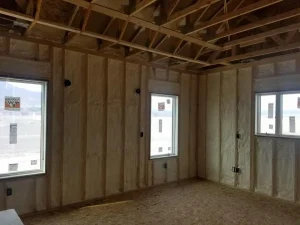
Moisture barrier properties represent another significant but often overlooked value difference. Closed-cell spray foam functions as both an air barrier and vapor retarder, eliminating the need for separate housewrap or vapor barrier products. This consolidation reduces material costs and simplifies construction details while improving overall building envelope performance.
Fiberglass insulation provides no meaningful air sealing and requires additional materials and labor to create proper air barriers. Separate vapor retarders, weather-resistant barriers, and meticulous sealing around penetrations add complexity and cost to achieve performance levels that spray foam delivers inherently.
Sound attenuation qualities differ between materials in ways that affect occupant comfort and property value. Spray foam provides superior acoustic dampening, reducing sound transmission between spaces and from exterior sources. This characteristic enhances privacy in multi-family dwellings and creates quieter interior environments in commercial applications.
The Townsend region experiences temperature swings that create condensation risks within building assemblies. Proper insulation selection and installation prevent these moisture problems that lead to rot, mold, and structural damage. Property owners who prioritize long-term building health increasingly favor spray foam despite higher initial costs.
Professional Guidance and Installation Quality
Selecting insulation materials requires careful evaluation of immediate budget constraints against long-term performance and cost implications. Properties with limited initial budgets may find fiberglass appropriate for certain applications, while critical areas benefit from spray foam’s superior characteristics. A mixed approach sometimes delivers optimal cost-effectiveness.
Application-specific factors influence material selection in ways that affect total project costs. Crawl spaces and rim joists particularly benefit from spray foam’s air sealing capabilities, while large open attic spaces might accommodate fiberglass more economically. Understanding these nuances prevents overspending while ensuring adequate thermal performance.
Installation quality dramatically affects real-world performance for both materials. Poorly installed fiberglass leaves gaps, compression, and thermal bridges that undermine rated R-values. Spray foam application requires proper surface preparation, correct temperature conditions, and precise mixing ratios to achieve specified performance characteristics.
Montana’s climate demands attention to building science principles that many contractors overlook. Proper vapor management, thermal bridging elimination, and continuous insulation layers require knowledge that extends beyond basic installation techniques. Working with experienced professionals who understand regional building challenges ensures that insulation investments deliver expected returns.
Elkhorn Insulation, Inc. brings extensive knowledge of insulation materials and their appropriate applications throughout Montana. Our team evaluates each property’s specific needs, considering budget parameters alongside performance requirements to recommend solutions that deliver optimal value. Whether your project calls for spray foam insulation, fiberglass installation, or a strategic combination, we provide honest assessments based on building science principles rather than material preferences.
Properties throughout Helena, Big Sky, and surrounding communities face unique insulation challenges that demand professional expertise. Our installation teams maintain certification in advanced application techniques, ensuring that materials perform as specified regardless of challenging conditions. We understand that insulation represents a long-term investment in property performance, and we approach every project with the attention it deserves.
The true cost difference between spray foam and fiberglass extends far beyond initial price comparisons. When factoring energy savings, longevity, maintenance requirements, and additional protective benefits, spray foam frequently emerges as the more economical choice over a property’s lifetime. However, each situation presents unique variables that merit individual evaluation rather than blanket recommendations.